thanks to Mario for the picture!
thanks to Mario for the picture!
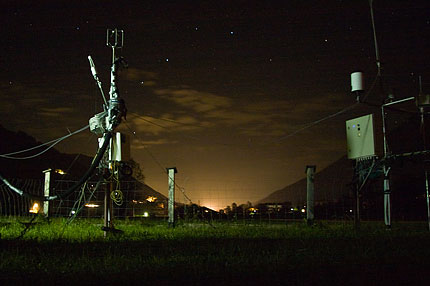
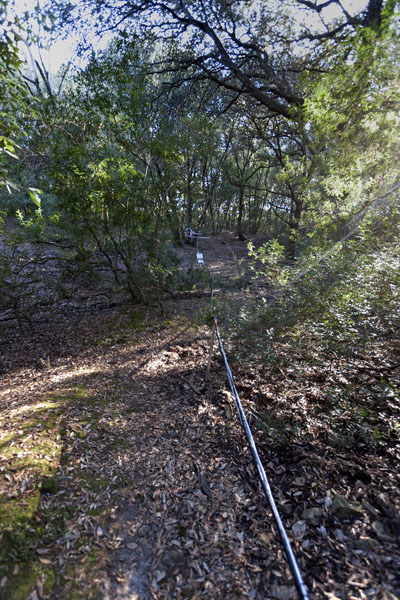
In between two meetings in France, Jay Arnone (DRI, Reno, NV, USA) was visiting us to work on the MGCF flux data set, which since our 2008 paper in GCB has grown to a length of 12 years and promises lots of new insights into inter-annual variability of desert carbon cycling.
This week we hosted a mini-workshop funded by the COST action OPTIMISE to develop a web-based tool that merges flux footprint modeling using the approach by Kljun et al. (2015) with an unsupervised land cover classification using Sentinel-2 and Bing data to devise optimal sensor placement for linking flux measurements with proximal sensing.
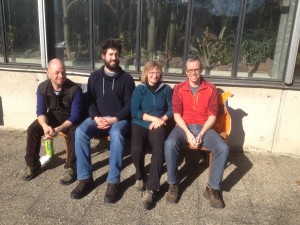
(from left to right: Enrico, Tarek, Natascha and Georg)
Mallick K., Jarvis A., Wohlfahrt G., Kiely G., Hirano T., Miyata A., Yamamoto S., Hoffmann L. (2015) Components of near-surface energy balance derived from satellite soundings – Part 1: Net available energy. Biogeosciences 12,433-451, doi: 10.5194/bg-12-433-2015.
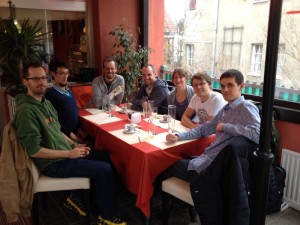
Today Genki Katata, presently visiting scientist at KIT Garmisch-Partenkirchen, visited us to discuss about modelling grassland carbon and energy fluxes. The picture shows Genki (second on left) and part of the Biomet group enjoing lunch after an exhausting discussion about Bayesian calibration, parameter equifinality and other complicated stuff.
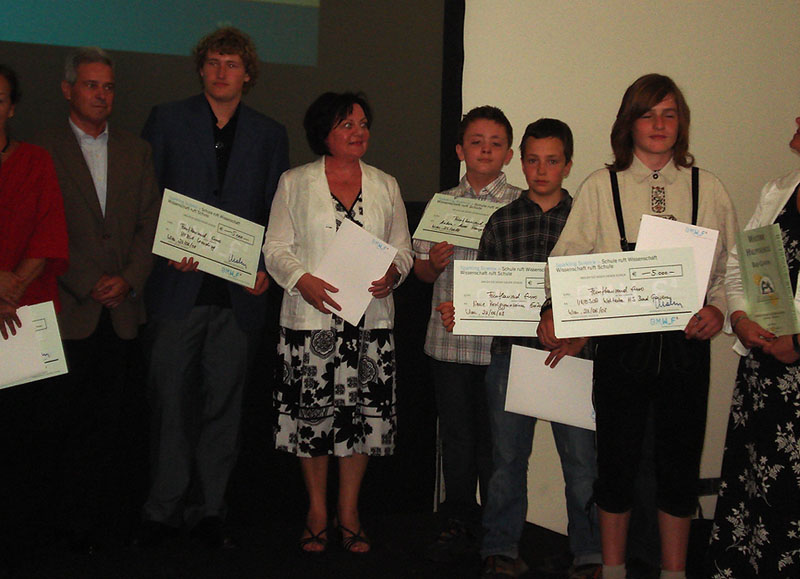
 Katharina (fourth from left) and Felix (leftmost) were officially awarded their PhD fellowships by the University of Innsbruck (picture courtesy of university press office).
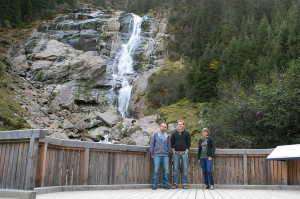
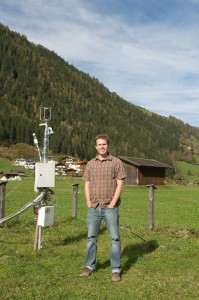
Paul Stoy visited us (pictures showing him at our field site Neustift and together with Albin and Katharina at the Grawa waterfall in Stubai Valley) to give a presentation on “Interpreting processes by observing patterns: Data-intensive strategies for understanding the role of ecosystems in the climate system”.
New paper: ,, , , , , Knohl A. (2014) Soil H2 18O labelling reveals the effect of drought on C18OO fluxes to the atmosphere. Journal of Experimental Botany 65, 5783-5793. doi: 10.1093/jxb/eru312.