


Slide 1 Slide 2 Slide 3 Slide 4
Example Frame

Heatwave effects @FAIR site

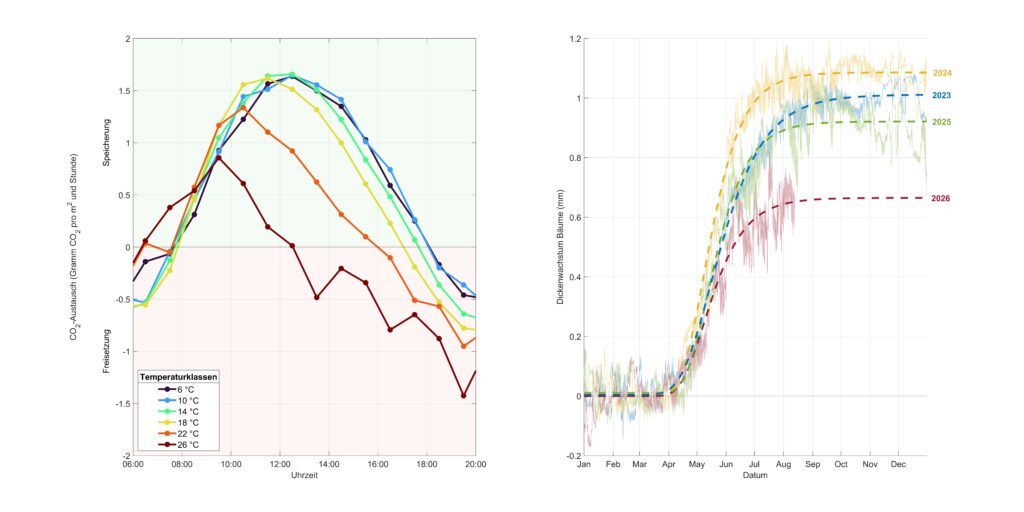
Albin has produced the figure below showing that once air temperature exceeds 20°C tree CO2 uptake, derived as the difference between the above- and below-canopy eddy covariance CO2 flux measurements, starts to show reductions in the afternoon. These reductions are likely caused by stomatal closure in response to the rising evaporative demand of the atmosphere. As temperatures and the vapour pressure deficit continue to rise, the impairment starts to shift towards earlier hours of the day. Under the hottest days of the recent heatwaves, finally, reductions in CO2 uptake commenced already in the early morning and around midday, the tree crown started to emit CO2 on a net basis.

These reductions in CO2 uptake also start to show up in the tree increment, which is slated for the lowest value since we started measurements.

New paper

Schmack J., de Vries A., Spielmann F., Schnitzler J.-P., Winkler J. B., Weber B., Wohlfahrt G., Karl T., Jod W. (2026) Species-specific BVOC emission dynamics of Pinus sylvestris and Juniperus communis during different drought intensities. Plant Stress 22, 101480, doi: 10.1016/j.stress.2026.101480. [OPEN ACCESS]

New paper

Jones S.R, Wohlfahrt G., Friend A.D., Franks P.J., Cheesman A.W., Cernusak L.A., Diao H., Feng X., Urban J., Taylor T., Slot M., Mercado L.M., Cox P.M. (2026) Stomatal decoupling from photosynthesis under high temperatures is consistent with stomatal optimisation. Global Change Biology 32, e70972, doi: 10.1111/gcb.70972. [OPEN ACCESS]

New paper

Shtai W., Petrie P., Bonada M., Edwards E., Wohlfahrt G., Tagliavini M. (2025) Physiological response of grapevine (cv. Shiraz) to drought, light exposure and heat stress. Oeno One, doi: 10.20870/oeno-one.2026.60.2.10075. [OPEN ACCESS]

  1. Pages:
  2. 1
  3. 2
  4. 3
  5. 4
  6. 5
  7. 6
  8. 7
  9. ...
  10. 105